
Together they make the Company’s history visible.
Explore the collection
Pair of loving cups (1854)
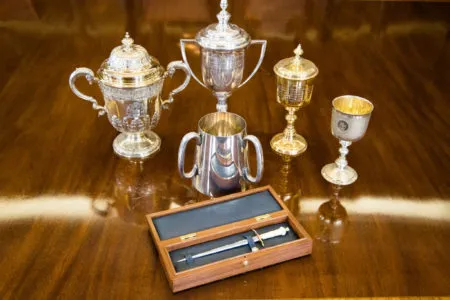
Presented in 1854 by James Scott Smith of the Whitechapel & Phoenix Distillery, who served as Master in 1849.
Dirk (1982–83)
Presented by the Chairman and Directors of the Distillers Company Ltd, now part of Diageo, to mark the Mastership of their colleague Michael Boileau Henderson in 1982–83.
Eight decanter labels (1988)
Made in 1988 for the 350th anniversary of the Company’s incorporation, each label carries the Coat of Arms. Members of the Livery presented the first set to Queen Elizabeth II.
Four goblets (1930–31)
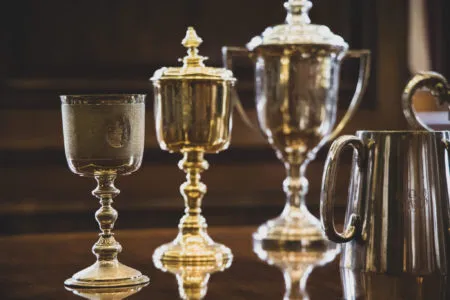
A gold goblet for the Master and three silver goblets for the Wardens, given by E. Price Hallowes, Master in 1930–31.
Gavel (1855–56)
Used by the Master at meetings of the Court and presented by Charles Curtis, Master in 1855–56.
Pair of quaichs (1966)
Presented by the London Scottish Regiment in 1966, a year after the beginning of its formal affiliation with the Company.
South Africa Medal with seven clasps (1900)
Presented to the Company by King Edward VII in recognition of the part it played in raising and equipping the City of London Imperial Volunteers in 1900.
Tercentenary Appeal Fund Cup (1672–1972)
Created to mark the period 1672–1972. The Appeal Fund was supported by 107 Liverymen.
The Beadle’s stave head (c. 1690)
The silver-mounted head of a six-foot ceremonial staff, probably dating from around 1690. Its finial is decorated with acanthus leaves and topped by the Company’s arms.
Victorian silver-gilt rose-water dish and ewer (1849)
Made in the form of a baluster still and presented in 1849 by Joseph Benjamin Claypole, then Master. The piece is placed on the Master’s table at Company functions.
Loving Cup (2018)
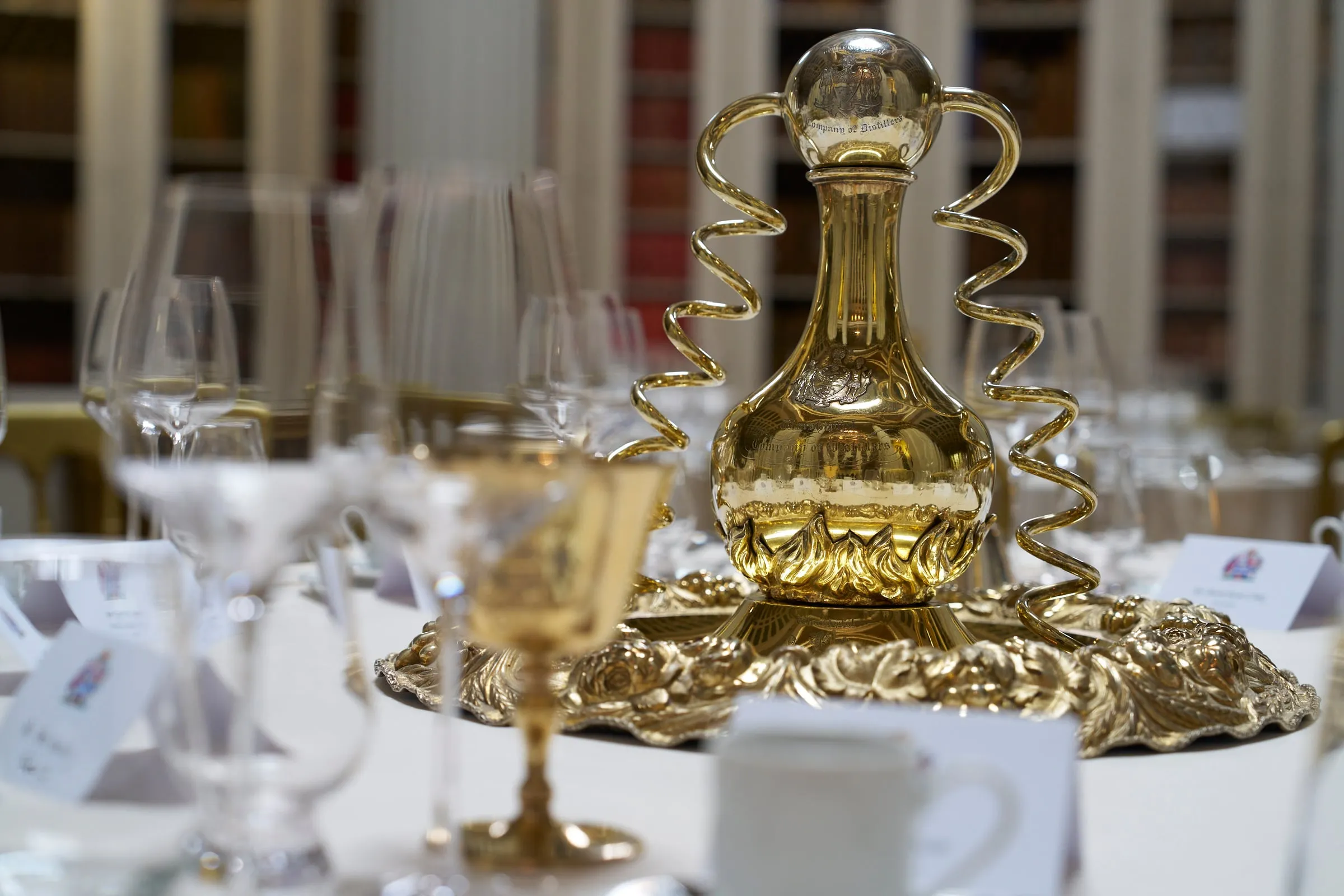
Commissioned from Graham Stuart, a silversmith in Scotland, and presented to the Company in 2018 by Charles Minoprio, Father of the Court and Past Master.
The Loving Cup ceremony
The Loving Cup is one of the best-known traditions shared across the Livery movement. A large cup is passed from guest to guest. As each person drinks, their neighbours turn outward in a symbolic act of protection before the cup moves on.
The ceremony is often linked to the killing of King Edward the Martyr while he was drinking, when a companion was asked to stand guard with a drawn sword. The Distillers’ Company is believed to be the only Livery Company to pass daggers with the cup, in place of that sword. Today it means trust, fellowship and mutual care.
Objects that still have a role
These treasures are still used. The gavel, goblets, ewer, loving cups and other pieces add meaning and continuity to Company occasions.
Explore the Company’s Coat of Arms